
Unsere drittmittelgeförderten Projekte im Überblick:
-
Gefördert durch den Freistaat Thüringen aus Mitteln des Europäischen Sozialfonds Plus
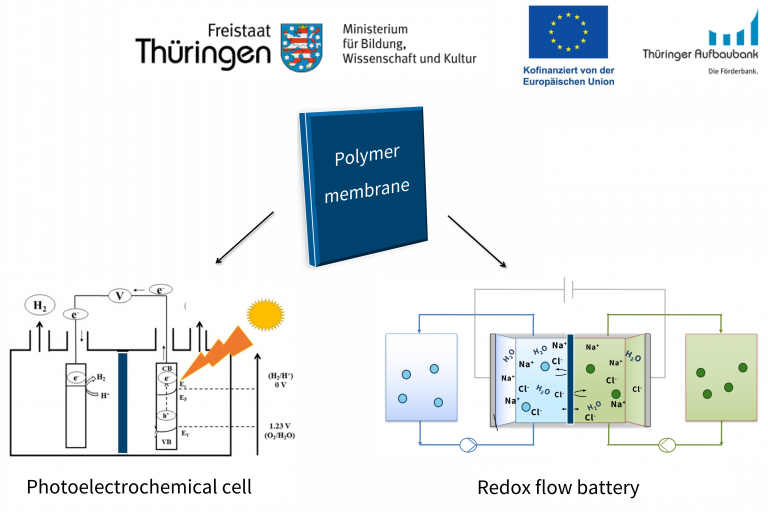
Polymermembranen spielen eine wichtige Rolle in vielen Energiespeichern und -wandlern.
Für viele Anwendungen sind fluorhaltige Polymere (z. B. Nafion) das Benchmark-Material, welche aus Sicht der Nachhaltigkeit jedoch bedenklich sind.
Wir untersuchen deshalb fluorfreie Polymermembranen für wässrige organische Redox-Flow-Batterien (RFB) und für photoelektrochemische Zellen (PEC) zur Wasserstofferzeugung und Oxidation von Glycerin. Dafür haben die Mitarbeitenden in den Arbeitsgruppen von Prof. U. S. Schubert, Prof. Yan Lu, Prof. Felix Schacher and Dr. Marco Favaro ihre Expertisen in Polymersynthese, Membrancharakterisierung, Redox-Flow-Batterien und PECs gebündelt, um die neuen Entwicklungen auf den Weg zu bringen.
Projektlaufzeit: 01.01.2025-31.12.2027
Das HIPOLE Jena Projektteam: Prof. Ulrich S. Schubert, Prof. Yan Lu, Prof. Felix H. Schacher, Dr. Marco Favaro, Dr. Martin Hager, Dr. Mosayeb Gharakhloo, Mohammed Jamshied, Moritz Kunze, Kai Hetze, Thomas Halmanseder, Dzenna Zukova und Vikram Raghuraman.
-
Gefördert durch den Freistaat Thüringen aus Mitteln des Europäischen Sozialfonds Plus
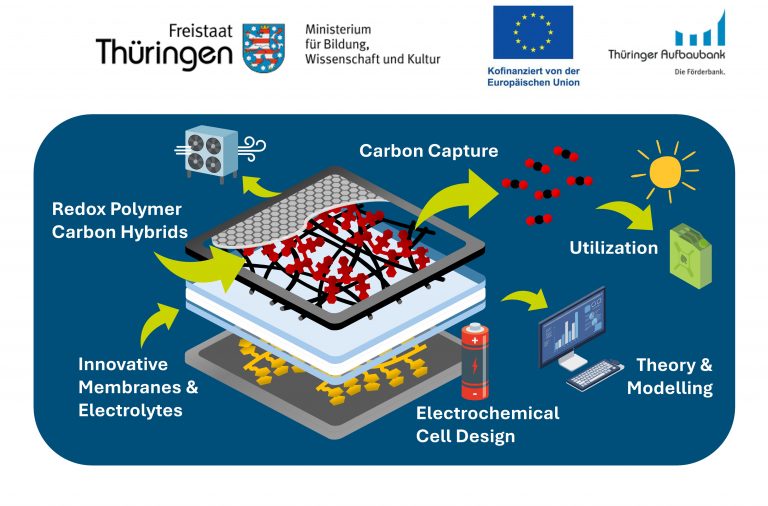
Für das Erreichen der Klimaziele und die Begrenzung der globalen Erwärmung ist eine Verringerung der Konzentration von Kohlenstoffdioxid in der Erdatmosphäre mittelfristig dringend erforderlich.
Um dies umzusetzen, existieren unterschiedliche technologische Ansätze. Die Forschergruppe PolyCapture verfolgt die direkte Bindung von Kohlenstoffdioxid aus Luft mittels elektrochemisch schaltbarer Materialien. Zentrale Zielstellung ist die Entwicklung neuer nanostrukturierter Hybridmaterialien aus redoxaktiven Polymeren und Kohlenstoffen, die über den Einsatz von Strom in einen Adsorptions- und Desorptionszustand geschaltet werden können. Die Kombination der schaltbaren Polymere mit leitfähigen Kohlenstoffnanofasern soll hohe Ströme ermöglichen und dadurch eine verbesserte Abscheidungsrate von Kohlenstoffdioxid sowie erhöhte elektrochemische Stabilität im Hinblick auf eine zukünftige technische Implementierung bewirken.
Die notwendigen Kompetenzen in der Materialsynthese, Prozesstechnik, Modellierung und der Erprobung von Verwertungsszenarien von Kohlenstoffdioxid auf der Basis von erneuerbaren Energien werden durch die beteiligten Arbeitsgruppen von Prof. Oschatz, Prof. Mollenhauer, Jun.-Prof. Pannwitz, Prof. Schacher und Prof. Schubert zusammengeführt.
Projektlaufzeit: 01.01.2026-31.12.2028
Das HIPOLE Jena Projektteam: Prof. Martin Oschatz, Prof. Doreen Mollenhauer, Jun.-Prof. Dr. Andrea Pannwitz, Prof. Dr. Felix H. Schacher, Prof. Ulrich S. Schubert, Dr. Samaneh Khodami, Sofiia Prykhodska, Diego Bitzenhofer Betolaza und Fabian Knötzsch.
-
Gefördert durch das Bundesministerium für Forschung, Technologie und Raumfahrt (BMFTR) im Rahmen von M-ERA.NET III
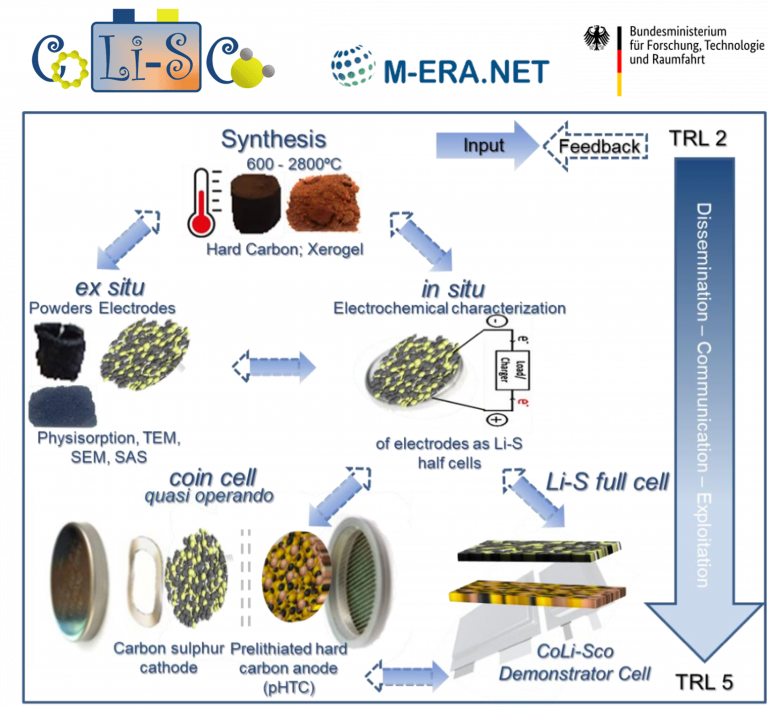
Fortschrittliche und nachhaltige Energietechnologien sind ein zentraler Baustein für europäische sowie globale Nachhaltigkeitsziele.
Lithium-Schwefel-Batterien (Li-S) gelten dabei als vielversprechende nächste Generation elektrochemischer Energiespeicher. Sie zeichnen sich durch eine hohe theoretische Kapazität und Energiedichte sowie durch die gute Verfügbarkeit und Umweltfreundlichkeit des Elements Schwefel aus. Der Weg in die industrielle Anwendung wird jedoch bislang durch Herausforderungen wie die geringe elektrische Leitfähigkeit der Materialien, Polysulfid-bedingte Nebenreaktionen und zyklusbedingte Stabilitätsprobleme erschwert.
Im Projekt CoLi-SCo arbeiten wir daran, diese Lücken zu schließen. Ziel ist es, die Materialentwicklung mit der praxisnahen Zellentwicklung zu verbinden und dabei einen klaren Fokus auf Nachhaltigkeit und Skalierbarkeit zu legen. Durch einen Multiskalenansatz – von der Strukturierung nanoporöser Kohlenstoffmaterialien über das Elektrodendesign bis hin zur Fertigung von Li-S-Beutelzellen – sollen die Zusammenhänge zwischen Materialeigenschaften, Elektrodenarchitektur und Batterieleistung umfassend verstanden und optimiert werden. Das Konsortium verfolgt dabei zugleich nachhaltige Strategien in der Materialwahl, der Elektrodenherstellung und dem späteren Recycling. Auf diese Weise soll der Technology Readiness Level von Li-S-Batterien gezielt erhöht und ihre Einführung in die europäische Energielandschaft beschleunigt werden.
Neben HIPOLE Jena beteiligen sich folgende Einrichtungen am Projekt:
- Friedrich-Schiller-Universität Jena
- Orion Engineered Carbons GmbH
- Poznan University of Technology (Polen)
- Agencia Estatal Consejo Superior de Investigaciones Científicas (Spanien)
- Lukasiewicz Research Network (Polen)
- INNOVATOR Sp. z o.o. (Polen)
Projektlaufzeit: 01.10.2024 – 30.09.2027
Das HIPOLE Jena Projektteam: Prof. Martin Oschatz, Dr. Eneli Härk und Dr. Felix Nagler.